



Why Benchling Leaders Are Prioritizing AI Fluency
“If we’re going to help our customers move faster with AI, we need to understand it ourselves.”

That’s the “why” behind Benchling’s decision to host an internal AI Week, where employees across every department were empowered to build their own AI tools with their peers, said Head of Talent Dean Talanehzar. Benchling provides scientists with software designed to accelerate drug development, and its leadership sees AI as the key to empowering every team to move more quickly and effectively in bringing new solutions to customers.
What Does Benchling Do?
Benchling is the AI platform for R&D, where scientists design experiments, capture structured data, and run AI agents and models directly in their workflows. Over 200,000 scientists around the world trust Benchling to power their most important work, from academic labs to Sanofi, Moderna, and more than half of the world's top 50 biopharma.
Alongside Chief People Officer Meg Makalou, Talanehzar led the planning and execution of AI Week while collaborating with employees from various departments, including IT, security and finance. Together, they researched how other companies ran similar events, and then designed the structure, coordinated infrastructure, managed communications and recruited internal “AI Champions” to support teams during the event.
“A lot of our energy went into making it approachable: clear fluency tracks, projects tied to real workflow problems and messaging that said ‘no experience required’ and meant it,” Talanehzar said.
A month before AI Week commenced, Benchling gave all of its employees access to Claude Enterprise, enabling them to familiarize themselves with the technology before using it to build their own tools during the event. All of these efforts made AI Week an accessible, impactful experience that one team member described in a gratitude post as “seamless and super inspiring.”
How Benchling Teams Collaborated During AI Week
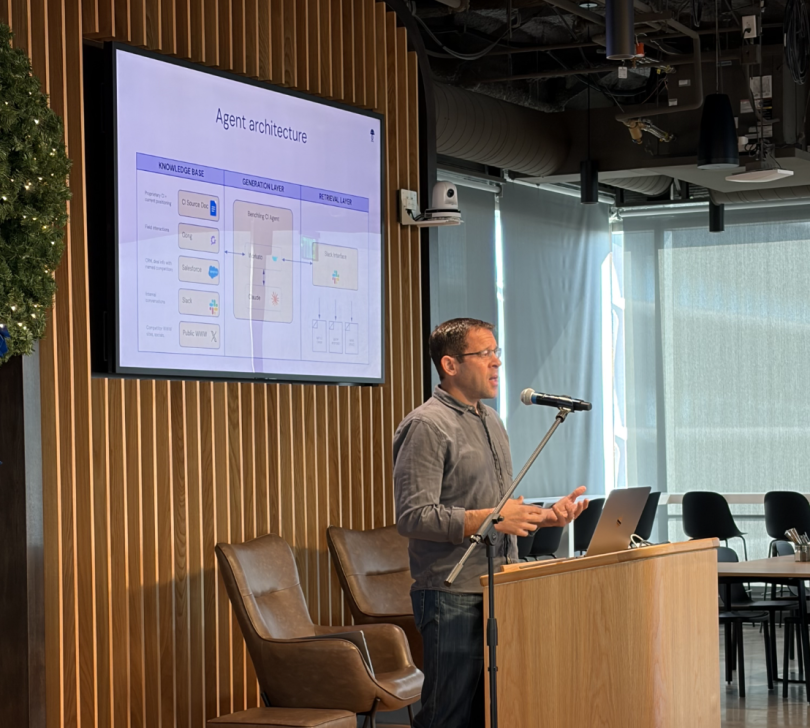
AI Week was held across Benchling’s San Francisco headquarters, Boston and Zurich offices, while remote employees joined via Slack and Zoom, ensuring everyone was able to participate.
What Was AI Week at Benchling?
AI Week was a companywide event where employees across departments used Claude Enterprise to work in teams, solve workflow problems and build practical AI tools. It included AI Champions, IT support, team Slack channels and show-and-tell demos at the end of the week.
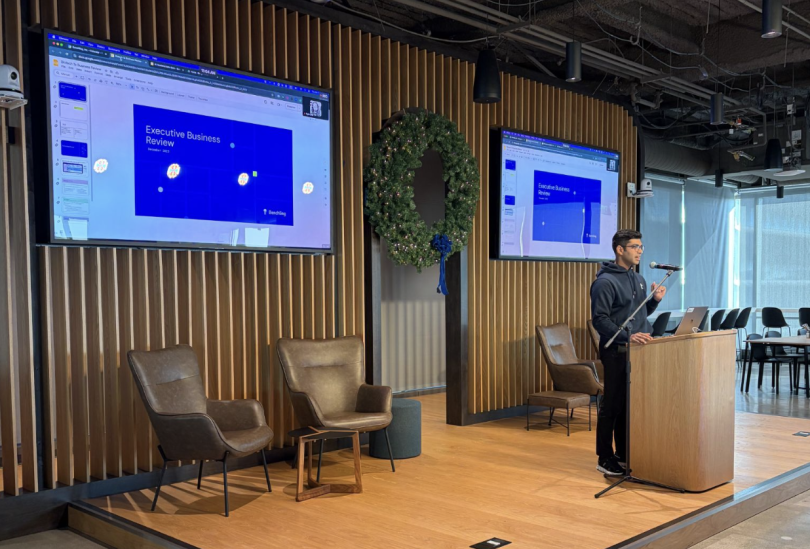
To kick off AI Week, Benchling CEO Saji Wickramasekara joined a companywide Zoom call to explain why AI fluency matters for the company’s future, setting the tone for the AI innovation that followed for the remainder of the week.
Meanwhile, Talanehzar helped set expectations, sort people into project teams and talked about how the success of the event would be measured.
“The message was simple: fluency, not perfection,” Talanehzar said.
“The message was simple: fluency, not perfection.”
Employees were then grouped into teams, placed into a team-specific Slack channel and given a problem to solve with AI and their peers by using Claude Enterprise.
Throughout the event, Benchling’s IT team ran a Business Technology Bar to offer support for tools and troubleshooting. Meanwhile, “AI Champions” moved among teams to offer coaching and help them overcome any challenges during the development process. The workplace team made sure everyone stayed energized by providing treats and drinks throughout the week.
According to Talanehzar, the goal of this ongoing support was to make collaboration easier.
“For a lot of people, the unlock wasn’t just the tools themselves — it was learning from the person sitting next to them,” Talanehzar said.
How Benchling’s AI Week Drove Innovation and AI Skill Growth
For Talanehzar, one of the most memorable aspects of AI Week was seeing non-technical team members build solutions they didn’t think they could.
“People who came in at a self-reported confidence level of one or two out of five showed the biggest gains by the end of the week,” Talanehzar said.
Teams from every department created compelling solutions. For instance, a finance team built an automated reporting tool, while an HR team created a recruiting copilot. Other notable projects include an analysis agent, which was called out as having “massive” potential impact, as well as an AI headshots project and demo data generator.
There was a high level of cross-functional collaboration throughout the week, with engineers helping sales reps build tools, and product team members working with customer experience employees. This teamwork was visible in Slack, where people from across the company could be seen debugging prompts together and sharing their findings with each other.
The week ended with show-and-tell sessions. Each team demoed its solution, and employees were asked to vote on the best one after watching recordings of each demo.
“The mood was a mix of exhaustion and accomplishment,” Talanehzar said. “People had built real things in three days, many of them for the first time.”
What Impact Did AI Week Have at Benchling?
- An 85% Claude Enterprise adoption rate across the company
- 148 project ideas submitted across every division
- 72 active project teams formed with dedicated Slack channels
- 82% of survey respondents said that AI Week was a valuable use of their time
Benchling’s Strategy for Sustained AI Adoption
Benchling’s teams learned a lot during AI Week, both from a technical and logistical standpoint.
“AI Week proved that non-technical people can build useful tools when you give them the right resources and protected time,” Talanehzar said. “It also proved that execution matters as much as vision.”
“AI Week proved that non-technical people can build useful tools when you give them the right resources and protected time.”
Employees expressed their gratitude for the event, with one sharing that the planning team “held the entire project together in a way that shouldn’t have been possible.”
“It was genuinely a cross-functional effort, and seeing that recognized meant a lot,” Talanehzar said.
Upon the conclusion of AI Week, Talanehzar and the rest of the planning team analyzed 110 survey responses, gathered what worked and what didn’t, and presented an executive summary to the leadership team. In addition to identifying which projects were ready to ship and which ones needed more work, they scoped an ongoing AI Fluency program, which became a formal initiative that they presented to leadership earlier this year. The program includes division accountability frameworks, a plan for recurring events and metrics for sustained adoption.
“That’s been the foundation for everything we’ve built since,” Talanehzar said.
AI Week was a major learning moment for Talanehzar and others on the planning team. While not every tool turned out perfectly, the experience shed light on an important truth.
“The core bet, that companywide participation drives real transformation, was validated,” Talanehzar said.
Frequently Asked Questions
What does Benchling do?
Benchling provides an AI platform for research and development that is designed to help scientists design experiments, capture structured data, and accelerate drug development. Over 200,000 scientists around the world use the software, ranging from academic labs to major global biopharma companies like Sanofi and Moderna.
Does Benchling use AI?
Yes, Benchling heavily incorporates AI into both its product and its internal operations.
The platform allows scientists to run AI agents and models directly within their scientific workflows.
Internally, Benchling employees across all departments utilize Claude Enterprise to build practical tools, which has an 85% adoption rate across the company. Teams have used AI to build internal solutions like automated finance reporting tools, an HR recruiting copilot, analysis agents, and demo data generators.
What is Benchling's AI Week?
AI Week was a structured, companywide event held across Benchling’s San Francisco, Boston and Zurich offices, with remote employees joining via Slack and Zoom. The event aimed to build internal "AI fluency, not perfection," proving that non-technical employees could build useful tools when given protected time and resources. Employees were grouped into 72 active project teams and given three days to solve real workflow problems using Claude Enterprise. They were supported by a technical "Business Technology Bar" and internal "AI Champions" who offered coaching. The event resulted in 148 project ideas and concluded with "show-and-tell" sessions, where teams demoed their solutions.


